
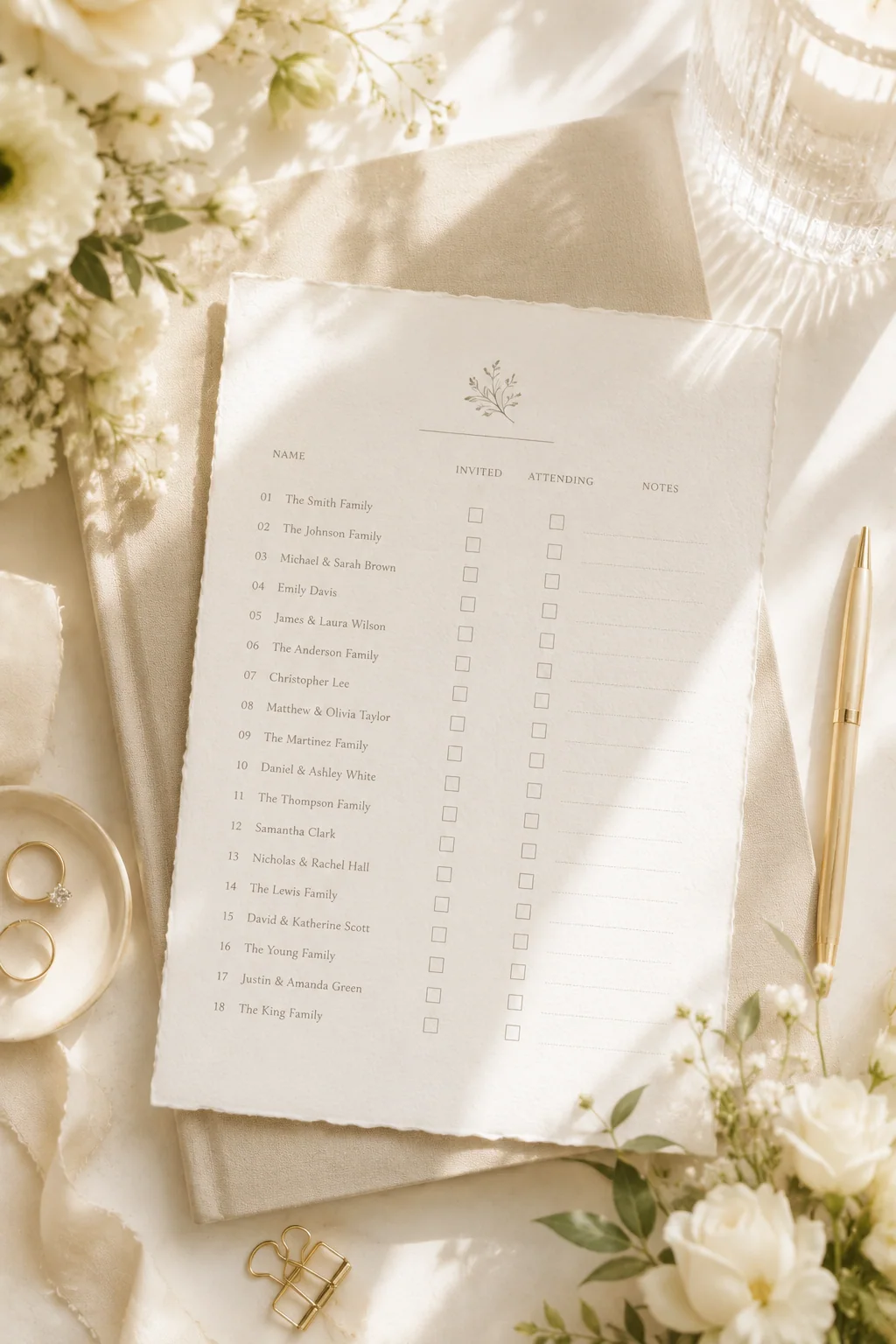
The wedding guest list is the most emotionally complicated document you will produce during planning. It is shorter than your timeline, smaller than your budget, and the source of more difficult conversations than both combined. Most couples underestimate how long it takes to build, how much it shapes the day's feel, and how much money is hidden in each name.
Where to start (and what not to do first)
The instinct is to open a spreadsheet and start adding names. Don't. The most useful first step is to decide, with your partner, what kind of wedding feel you want. Intimate or full? Family-centered or friend-centered? Dinner-party warmth or dance-floor energy? A 60-person wedding and a 160-person wedding are not the same event in different sizes. They are different events.
Once you have a feel target, work backwards into a guest-count range. Allow a generous 10-15% buffer because the list will grow. It always grows.
Then, and only then, start the spreadsheet.
The three-tier method
The cleanest way to build a guest list is to assign every name to one of three tiers. Be honest with yourself; this is where the math gets done.
Cannot imagine the day without them.
Parents, siblings, immediate family, the friends who would feel the absence personally. People you would call to tell them you got engaged. If your wedding got smaller because of a venue change or a budget shift, these people would still be there.
Would love to have them, but the day still works without them.
Close-but-not-closest friends, extended family you see at holidays, recent coworkers you genuinely like, partner's-side relatives you've met more than twice. These names will be the bulk of your list, and they are where the cuts will happen.
Inviting them out of obligation or social momentum.
Coworkers you don't socialize with, friends-of-parents you barely know, people who invited you to their wedding three years ago whom you haven't talked to since. Be honest. These names cost the same to feed as Tier A names.
Once names are tiered, your total guest count math becomes obvious. If A + B alone exceeds your target capacity, that's the conversation to have first, before you start cutting C. If A + B fits, you can extend invitations to C selectively or save-the-date them with a clearer expectation it's a smaller event.
Tier C costs the same to feed as Tier A. Be honest about who's there.
Plus-ones, dates, and the question of strangers
The standard etiquette: every guest in a serious, named relationship (married, engaged, cohabitating, dating for over a year or so) gets a plus-one with their partner's name on the invitation. Beyond that, you have discretion. Here's a practical rubric:
- If you've met the partner, name them on the invitation. Always. Even if you don't love them. It's their relationship, not yours.
- If you haven't met but they're long-term, name them anyway. Ask your friend for the name; don't write “and Guest.” It signals you didn't bother.
- If your friend is single, you decide. Most couples extend plus-ones to single friends only if those friends won't know other guests. It prevents the awkward arrived-alone-knows-nobody moment.
- If your venue is at capacity, plus-ones are the first lever. Cutting unnamed plus-ones is less painful than cutting tier-B friends.
The kids question
Three approaches, in increasing order of restriction:
- All kids welcome. Easiest socially. Hardest logistically. Plan accordingly with a kids' table or supervised activity area.
- Family kids only. Your nieces, nephews, immediate-family kids are invited; broader friend-circle kids are not. Most common compromise.
- Adults-only wedding. Phrase it clearly on the invitation (“Adults-only celebration”) so there's no ambiguity. Some parents will be disappointed, some will be grateful. Most will understand.
Whatever you choose, apply it consistently. The exception that destroys the rule is “we invited the bride's-side kids but not the groom's-side kids,” or vice versa. Pick a principle and stick to it.
When parents want to invite their own list
The most common tension during guest-list building. Your parents (or partner's parents, or both sets) hand you a list of 30 people you've never met. Sometimes they're paying for the wedding, which complicates the math further.
A framework that works for most couples:
- Acknowledge their list publicly. “We want to honor who's important to you” is not lip service; it's a real value.
- Set a number, not a no. “We have room for 20 of your additions, can you prioritize?” is much easier to navigate than “no extras.”
- If they're paying, the math gets harder but the principle holds. Money doesn't mean unlimited invitations. It means a real conversation about how much they contributed, how much that buys, and what you're comfortable with.
- Get both sets of parents on the same number. If your parents got 20 add-ons, your partner's parents get 20 too. Asymmetry is what causes long-term resentment.
How to cut without it feeling cruel
If your initial list exceeds your venue capacity or budget, you'll need to cut. Some principles:
- Cut by category, not by person. “We're not inviting coworkers” is easier to defend and easier to hear than “we're not inviting you, Janet from marketing.” Apply the category rule consistently.
- Cut the Tier C list first, in full. Half-inviting tier C creates more problems than fully cutting it.
- If you cut to a B-list, never let it become known. “B-list” energy is the energy you most want to avoid. Send save-the-dates only to people you're sure about. Late invitations should not feel late.
- Have your partner cut their side. You cut yours. Don't make each other the bad guy.
Conversation scripts that actually work
Some real lines that have worked for real couples we've talked to.
To a parent pushing for more guests
“We love that you want everyone there. Our venue caps us at 110, and we've already given each of our parents 20 names. We can extend a few more, but we'd love to keep it close to people we'll all actually get to spend time with on the day.”
To a friend asking why they weren't invited
“We had to make our list really small to fit our venue, and we're so sorry. We'd love to celebrate with you separately, [coffee / dinner / drinks] after the wedding. It honestly broke my heart to draw the line where we did.”
To yourself, when the math hurts
“Every person we cut, we cut for a reason. The wedding will still be full of the people who matter most. Capacity is a constraint, not a value statement.”
The guest list will probably be the hardest conversation of your engagement. It's also the one that most shapes how the day actually feels. Build it slowly, honestly, and together.