
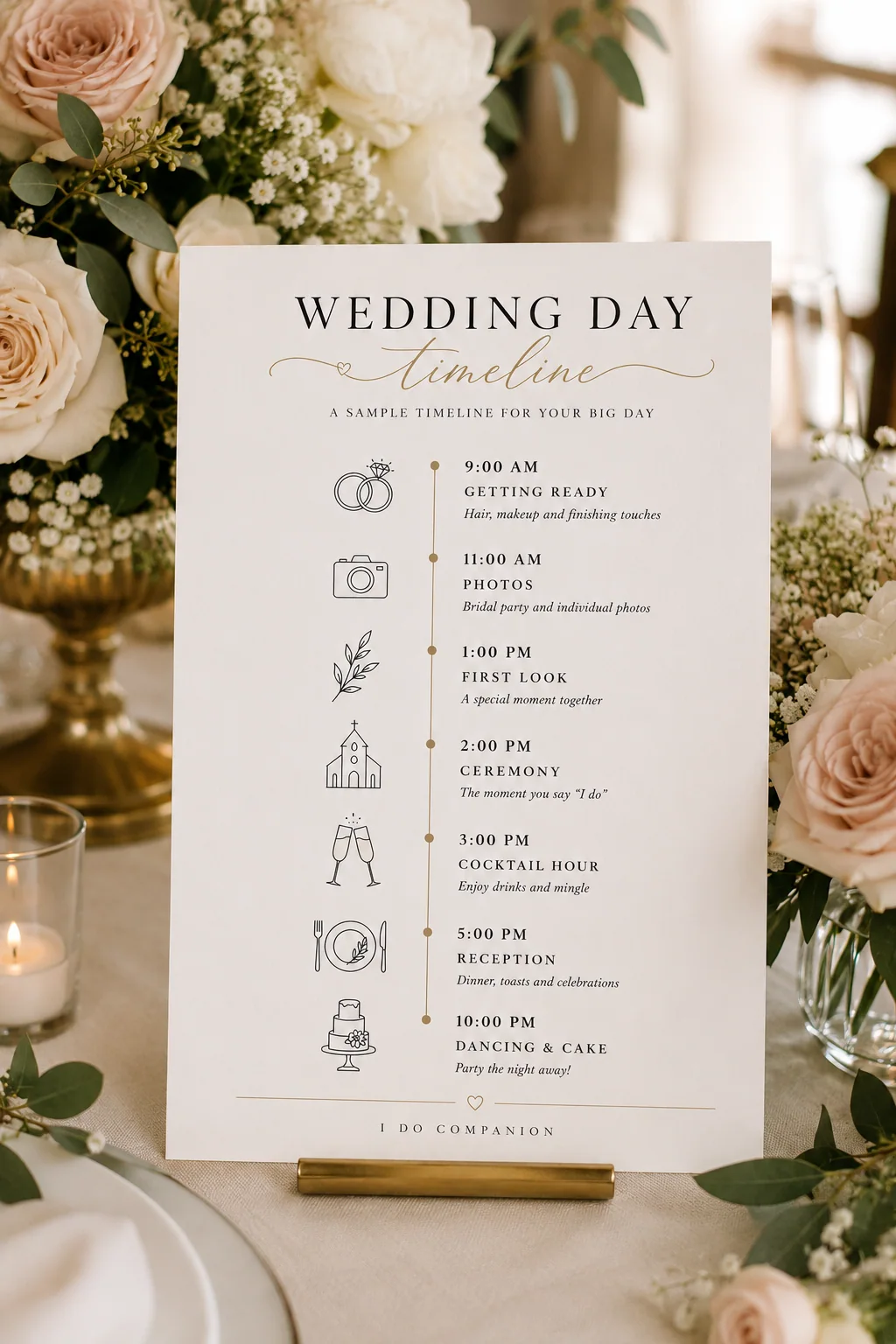
A wedding day timeline is a minute-by-minute plan that tells you, your partner, your vendors, and your designated helpers what is supposed to happen, when, and where. It is the single most useful document you will produce during planning. Good timelines reduce day-of stress more than any other piece of preparation.
Why your timeline matters more than your invitations
Couples spend hours choosing typefaces for save-the-dates and minutes building the document that actually runs the day. That ordering is backwards. Your invitations communicate one thing to one audience for ten seconds. Your timeline communicates dozens of things to a dozen vendors and helpers across an entire day, and it determines whether you spend the afternoon present in your own wedding or fielding “what happens next” questions.
Good timelines do three things: they tell vendors exactly when to arrive and what's expected of them, they tell your designated helpers what they're responsible for and when, and they give you and your partner a clear mental map so you can stop worrying about what's next and stay in the moment. They are not aspirational. They are operational.
Most wedding photographers we've spoken to say the same thing: the most-organized couples they work with all share one trait, which is a written, printable, time-stamped timeline that arrived in their inbox at least a week before the wedding.
The seven anchor moments every timeline needs
Build your timeline backwards from the ceremony start time. Every other anchor moves around it. The seven anchors most couples need, in chronological order on the day itself:
- Hair and makeup start. Almost always earlier than you think. Allow 45 to 60 minutes per person plus a 20-minute buffer.
- First look (optional). Most couples who do a first look say it calmed nerves and freed up time for portraits. Couples who skip it say the aisle moment was unforgettable. Either is right.
- Wedding party and family portraits. The block that always runs over. Build in 30% more time than your photographer estimates.
- Ceremony start. Your anchor. Print this in bold.
- Cocktail hour. Usually one hour. Use this time for couple portraits if you skipped a first look.
- Reception entrance and first dance. Tell your DJ exactly which song, who's announcing what, and in what order.
- Last dance and send-off. Decide whether you want a sparkler exit, a quiet slip-away, or a final dance party moment. Your venue's noise curfew will set the upper bound here.
A real sample timeline
Below is a working timeline for a 5:00 PM outdoor ceremony with 110 guests, garden venue, traditional reception. Adapt the times to your ceremony start by shifting everything proportionally.
5:00 PM ceremony · 110 guests · garden venue
A timeline is not a script you have to follow perfectly. It's a structure that lets you stay present.
Buffer time: the hidden art
The single most common timeline mistake is not building in buffer. Couples want the day to feel efficient, so they pack the schedule end-to-end and assume everything will run on time. Nothing on a wedding day runs on time. Allow buffer in three places, always:
- Between hair/makeup finishing and photographer arriving. 15 to 30 minutes. You will need this for a panic moment, a forgotten earring, a touch-up.
- Between portraits ending and ceremony beginning. 30 minutes minimum. This is the couple's quiet window. Sit. Drink water. Take a minute. This is when you actually realize you're about to get married.
- Between dinner ending and dancing opening. 10 to 15 minutes. Gives staff time to clear, guests time to find the bar, the DJ time to transition the energy.
If you have a venue with a strict end time, build your buffer in earlier in the day, not later. Late buffer disappears under pressure. Early buffer compounds.
How to share your timeline with vendors
Don't email your full operational timeline to every vendor. They don't need the cake-cutting time; they need their own arrival and active windows. Send each vendor a tailored excerpt that includes:
- Their arrival time and load-in location
- Their active windows, with what's expected during each
- Names and phone numbers of the one or two people they'll coordinate with on the day
- Strike (departure) time and any post-event logistics
Send these no later than one week before the wedding. Send them again three days before in a reply chain so they're at the top of the vendor's inbox. Print copies and bring them in your day-of binder.
What to do when something runs late
Something will run late. Hair will take longer than allotted. A guest will need to be picked up from the airport in the middle of portraits. Your officiant will arrive ten minutes before ceremony. The most-prepared couples we've talked to handle late moments the same way:
- Don't try to make it up. If portraits ran 20 minutes late, don't compress cocktail hour. Push everything 20 minutes later.
- Tell your point person, not your guests. A designated helper or coordinator handles the cascading communication. You shouldn't be on your phone.
- Lean on the buffer. This is what it was there for.
- Skip something small if you must. Better to lose the seven-minute couple-and-grandparents portrait than to start the ceremony 25 minutes late.
The wedding-day timeline is the difference between a couple who remembers the day and a couple who remembers being asked questions during the day. Build it carefully, share it generously, and then hand it to someone you trust.